Stamps and combos
Every point a QSO earns comes from a fact about the contact, represented as a stamp. The stamp is created the moment the host confirms with QSL. A combo is a name for a pattern of stamps on one QSO. A combo doesn’t have any points of its own, it’s just a fun name for a combination of stamps on a QSO.
The how to score points page describes how and when points are assigned to a QSO and to the two participants in the contact.
Stamps
Some stamps have similar characteristics, for example, there are several stamps that are related to location, like Nessie (when someone is located on a lake), and Foreign Lands (when the host and the chaser are located in different countries). Stamps with similar characteristics belong to the same family.
These interpretations of location are made using the information in the APRS position report sent by the host and the chaser. The system is pretty good at interpreting these locations, it can usually figure out if you are on a lake and the name of that lake. But these calculations, including which country you are in, are limited by the resolution of publicly available datasets. If you are very close to a border between countries, or send approximate location precision in your APRS beacon report, APRS OTA might think you are in a different country than you actually are.
If you are on a boat in a slip, it might say you are at sea, or it might say you are on the land. The system doesn’t know about maritime exclusive economic zones or other maritime laws. If you aren’t on the land of a country, or a lake within a country, then you are deemed to be at sea. If one of the parties in a QSO is at sea, you can not earn the Foreign Lands stamp, because by definition if you are at sea, you are not in a country.
Remember rule #2,
this is for fun. OTA makes its best effort and whatever it decides is
final. There is no appeals process and no re-adjudication.
| Stamp | Family | Points | What it says |
|---|---|---|---|
| PTT | RF | 1 | You were on RF for both of your frames on this contact. |
| Foreign Lands | Country | 1 | You and the other party were in different countries. |
| Nessie | Water | 1 | You worked this contact from a lake. |
| Davy Jones | Water | 1 | You worked this contact from the sea. |
| Elmer | Mentor | 1 | You worked a host for one of their first 25 hosted QSOs. |
| Pileup | Pace | 1 | Five stations in under ten minutes starts a pileup. You worked this contact in the pile. |
| Two Hats | Duty | 1 | You chased another op while hosting your own. |
PTT
You were on RF for both of your frames on this contact.
Foreign Lands
You and the other party were in different countries.
Nessie
You worked this contact from a lake.
Davy Jones
You worked this contact from the sea.
Elmer
You worked a host for one of their first 25 hosted QSOs.
How the first 25 contacts are counted
An Elmer is ham radio’s word for a mentor. A brand new host needs patient chasers who will answer them while they are still learning how it all works, so the chaser earns this point rather than the host.
The window is the host’s first 25 confirmed contacts, counted across their whole time on the air rather than per op. Counting contacts instead of ops matters. A host who never managed to send a QSL has not been mentored by anybody, and if the window were “your first three ops” then a quiet op would burn a third of it. The host who most needs elmering is the one still fumbling the confirmation.
So only scoring contacts move the count:
- Repeat contacts do not count. Ten contacts with the same friend on a single op only count as one of the 25.
- A quiet op does not count. A HOST that never beaconed, an op nobody called, and an op full of chases the host never confirmed all leave the count where it was.
- The window can close in the middle of an op. Nothing special happens (yet) when the 25th contact is completed. After that, chasers who complete a contact won’t earn the Elmer.
You can earn an Elmer from the same host more than once, at most once per op, which is the ordinary first contact only rule.
Pileup
Five stations in under ten minutes starts a pileup. You worked this contact in the pile.
How a pileup is decided
Working a crowd is the most demanding thing a host does, and it is the one thing about an op a host cannot arrange. The Pileup stamp rewards hosts for sending QSLs to the operators in the pileup.
The pileup test is applied to each contact as the chaser calls. If five or more other stations chased the op in the ten minutes before the call arrived, then the contact was started in a pileup. Pileup stamps are applied to contacts which began during a pileup.
- Stations are counted, not calls. One station calling six times is one station, and all of a callsign’s SSIDs are one station.
- Everybody who called is counted, not just the ones still waiting. The ten minutes are counted back from the moment each station called. A host who works through the pile quickly has already cleared the earlier callers, so counting only the ones still outstanding would score a fast host nothing and pay a slow one instead.
- The clock is based on when the station called, not when the QSL is sent. One host answering many chasers takes longer to work through a pile than the chasers took to build it, and confirmations often arrive in a batch. Judging on confirmation time would invent pileups that never happened.
You still have to send the QSL. A stamp only ever exists on a confirmed contact, so a pileup you never work earns nothing.
A host can earn this on several contacts in the same op, and there is no cap on how many. Over the last month of ops, the busiest one would have earned six pileup stamps.
Seeing a pileup on the op timeline
Every op page draws a timeline. The row of blue dots below the red bar is the chase lane, one dot for each station that called, placed at the time their call arrived. The lane carries a pale blue band behind the dots when there is a pileup.
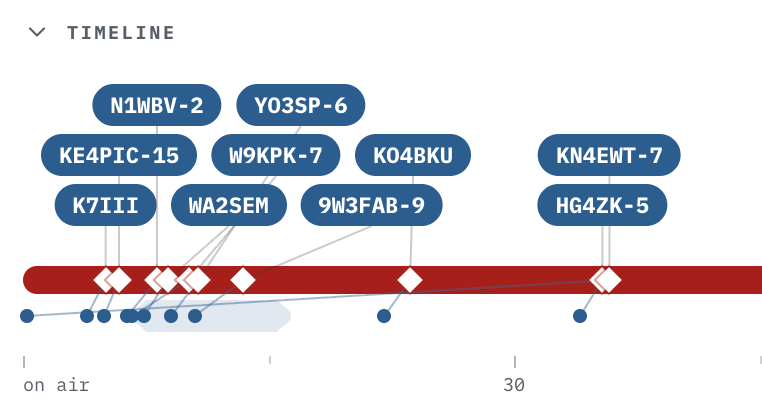
The pileup starts on the fifth caller, and that caller cannot earn the stamp, because the test needs five other stations already in the window. So the dot sitting on the band’s leading ramp is the contact that just missed. A dot in the solid part of the band was worked in a pileup.
A blue band can also hold no scoring contact at all. Five stations calling together is enough to start the pileup and draw the pale blue band, but if nobody else calls then there is never a sixth contact to earn the stamp.
The diamonds in the red bar are the confirmed contacts, and they are positioned based on the time the host sends the QSL. A diamond’s position on the red bar doesn’t tell you whether it was in a pileup. Read the diamond’s corresponding blue dot in the chase lane to see whether it was in the pileup.
Two Hats
You chased another op while hosting your own.
What counts as wearing both hats
You can chase somebody else’s op while hosting your own. When you do, you earn the Two Hats stamp because you are simultaneously filling both roles in different ops.
- Your own op has to be on the air. Both the HOST command and your position beacon have to be received by the OTA bot.
- Two Hats is based on the time you call. If the op you are hosting finishes before you receive the QSL from the op you chased, you still earn Two Hats for that QSO.
- SSIDs don’t matter here. Hosting from
-6and chasing from-9is one operator wearing two hats. You don’t have to do both from-6to qualify. - Chase as many ops as you want. While hosting, there is no limit or cap on how many other ops you can chase.
Combos
When the stamps on a QSO match one of the combo patterns below, a special combo graphic is shown instead of the original stamps. The combo doesn’t change the score, it celebrates the existing stamps with a unique name and graphic.
New combos can be defined which apply to old QSOs, but because combos don’t earn points, the previous score of the QSO will always remain what it was when it was completed.
| Combo | Pattern | Points shown |
|---|---|---|
| Two-Way | PTT + PTT | 2 |
| Nessie's Reunion | Nessie + Nessie | 2 |
| Full Fathom Five | Davy Jones + Davy Jones | 2 |
| Brackish | Nessie + Davy Jones | 2 |
Two-Way
Both of you were on RF for the whole exchange.
Nessie's Reunion
Both of you were on a lake.
Full Fathom Five
Both of you were at sea.
Brackish
One of you was on a lake, the other at sea.